

How to Choose the Perfect Outdoor TV for Your Patio
We boast some of the best year-round weather in the country in Fairfax County. It’s why in luxury homes across the area, outdoor kitchens and patios come to life with get-togethers. It’s natural to want to add a screen to these spaces to watch the Nationals play or to have a family movie night. That usually initiates the usual outdoor TV vs. indoor TV debate.
Indoor TVs seem like cost savers, but they lack the brightness and IP-rated weatherproofing required to survive Virginia’s humidity and solar heat. But even choosing outdoor-rated is just the beginning. Then it’s time to choose between shade, partial sun, and full sun models. The right choice should strike the perfect balance between image quality and your required budget.
SEE ALSO: Is Your Backyard Ready for the First Day of Spring?
What Do Sunlight Ratings Mean?
The main difference between outdoor TVs and indoor TVs is brightness. While indoor displays typically top out at 400 nits, which looks washed out even in shade, outdoor units are often over 2,000 nits to fight the sun. It’s common for our clients to think a full sun outdoor TV simply has more nits than a partly shaded one, but that is not the only difference.
Partial sun TVs usually include specialized technology to adjust brightness based on the available sunlight. Meanwhile, Full Sun TVs usually have additional cooling fans and heat-dispersing frames to prevent the screen from turning black from overheating.
What Outdoor TV Works Best In the Patio, Deck, or Pool?
Full shade models are usually the most affordable options with more of a focus on weatherproofing than extreme brightness. They’re ideal for areas with a solid roof that keeps the sun from ever directly hitting the screen. Top Suggestion: Covered Porches.
Partial sun models allow for more high-glare environments. They include an anti-reflection coating, brightness around 1,000-1500 nits, and ambient light sensors that automatically adjust the screen’s brightness and contrast in real-time. Top Suggestion: Deck.
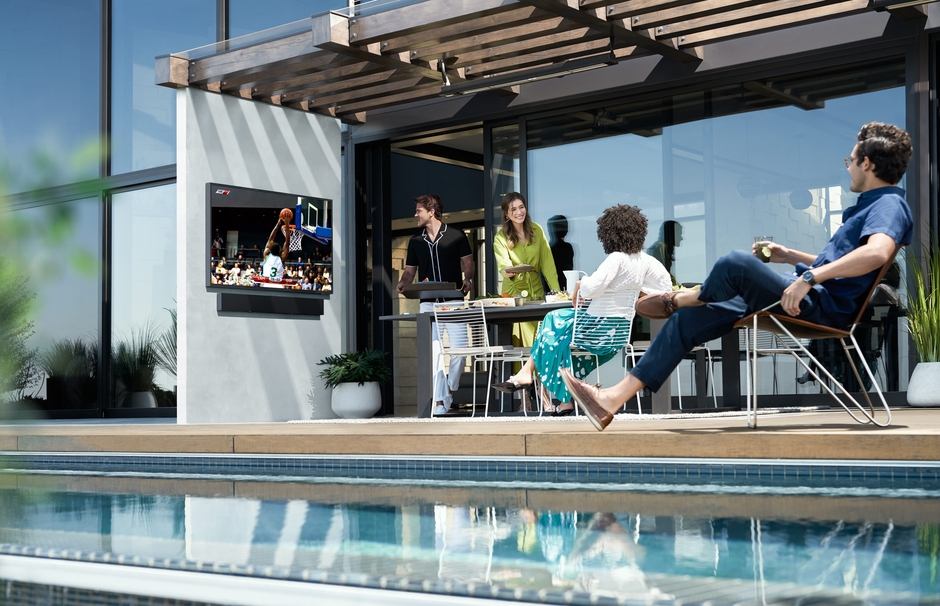
Full sun models are the premier outdoor TV option. Their premier models are worth the price with over 2,000 nits of brightness to deliver dynamic images even when the sun is directly overhead at high noon. Top Suggestion: Poolside
How Do You Know How Much Light to Expect?
Are you not sure how much sunlight your deck or patio gets during the day? We recommend doing a ‘shadow test’ at 10 a.m., 2 p.m., and 6 p.m.Take special attention to that low-angle afternoon sun that is the most aggressive and tends to sneak up on supposedly shared setups. It’s also worth remembering that the sun’s angles will change over time. The sun will be lower and most likely to cause glare in October (during prime football season) than in June.
Our expert technicians will always focus on the peak ambient light in your outdoor spaces and recommend hardware that will still deliver at those times. We’ll pair your TV with weather-resistant cabling and professional mounting. To finish it all off, we’ll link the TVs to Savant or Control4 for one interface to manage lighting, audio, patio heaters, and your display.
Understanding the nuances of sun exposure is the difference between a frustrating viewing experience and a backyard masterpiece. At A.B.E. Networks, we help you cut through the confusion to select the technology that fits your lifestyle. Call or fill out our contact form to talk to our AV specialists.
