
James Loudspeaker and Invisible Audio: When Custom Architectural Speakers Are Worth It
Custom architectural speakers are worth it when a room’s design leaves no good place for a standard speaker grille: a custom wood ceiling, coffered or beamed details, or a lighting plan with a deliberate rhythm. James Loudspeaker, part of Sonance since 2019, builds speakers to order for these rooms, including small aperture models whose openings blend with recessed lighting. Invisible speakers go a step further and disappear behind the surface entirely.
There is a moment in many projects when the designer, the architect and the family finally agree on something, and what they agree on is that no one wants to look at a speaker. That moment is why architectural audio exists, and the choices are wider than most people realize.
A.B.E. Networks has been a Sonance and James Loudspeaker dealer for many years. Here is how our audio team thinks about the options, and when each one is truly worth it.
How do we choose the right speaker for a room?
We start with three things: what the family wants to see, how the room is built, and how the space will be used.
When a family wants no visible speakers at all, invisible speakers are often the best choice. They mount behind the wall or ceiling and are finished over with the rest of the surface.
When we want the speakers to keep the clean, consistent look of fine recessed lighting, small aperture speakers are ideal. They deliver excellent sound with very little visual impact, and they are easier to service later than speakers hidden behind a finished surface.
When budget or purpose comes first, such as surround sound in a media room or music in a family room, conventional architectural speakers remain a great option. Even then, we usually choose modern, low profile grilles that blend into the room rather than older, bulkier designs. Many homes end up with different types in different rooms, each chosen for what that room needs.
What makes a small aperture speaker different?
It is less about the size of the opening than how it looks. Conventional and small aperture speakers both come in compact sizes, including 4 inch models. A small aperture design is made so its opening matches or hides among the room’s downlights, so it reads as part of the ceiling rather than as a speaker. Finishes can be customized too, including wood grilles that match a wood ceiling.
A room where a standard speaker would not work
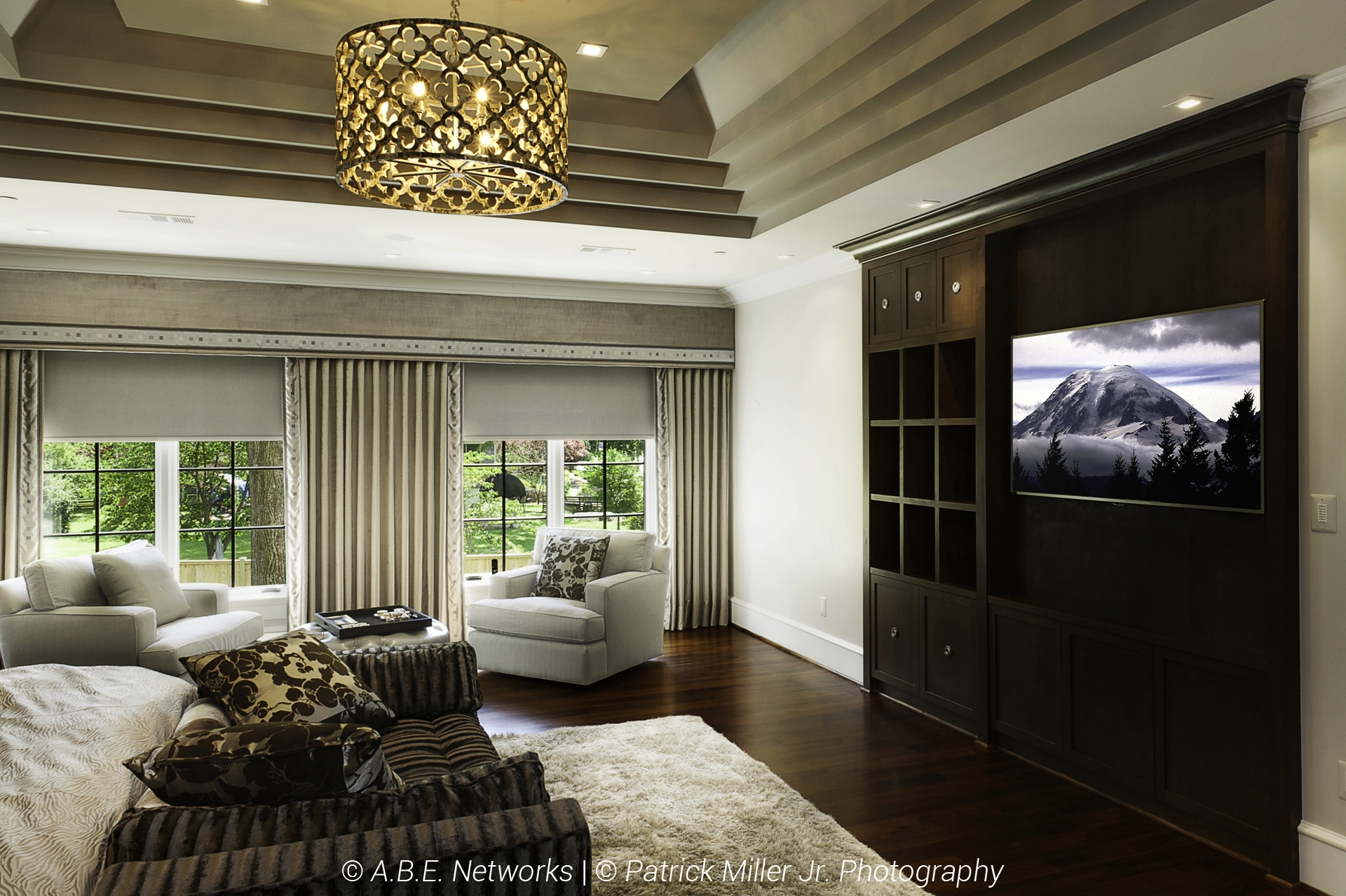
Our team has worked on projects with custom wood ceilings where traditional in ceiling speakers would have interrupted the architecture, and where invisible speakers were not compatible with the finished surface. Small aperture speakers gave those families high quality sound with minimal visual impact, and the ceilings look exactly as the architects intended. In rooms like these, the ceiling material and its details decide which options are practical.
When a room does not need anything custom, we will say so. A standard ceiling where a low profile grille looks lovely does not need a speaker built to order.
Do invisible speakers sound good?
Yes, very good. The surface itself becomes part of how the sound reaches the room. We think families deserve a plain answer, though: invisible speakers spread sound more broadly than a conventional speaker and can give up a little crispness at the top end. Modern designs have closed much of that gap, and they perform best with plenty of amplifier power behind them.
Are custom and invisible speakers expensive?
Price is rarely the first concern we hear. By the time a family is considering invisible or custom speakers, the design of the room and their own expectations have usually already shown that something specialized is needed. When families do compare options, our team walks through the differences in appearance, performance and installation so they can decide what suits the space. Our goal is never the most expensive speaker, only the right one for the room.
When should architectural speakers be planned?
During design, before framing. Placement and back boxes have to be coordinated with the other trades, invisible speakers need the drywall contractor to know they are there, and speakers built to order take time to make. In a finished home, small aperture and conventional speakers can be added without much disruption. Invisible speakers are possible too, but the work is very invasive because the surface has to be opened and refinished.
Frequently asked questions
What is the difference between Sonance and James Loudspeaker?
They have been the same company since 2019. Sonance covers the broader architectural and outdoor range, while James focuses on custom fabrication, small aperture designs and specialized outdoor and marine models.
Can speaker grilles match a wood ceiling?
Yes. Grilles and trims can be finished to suit the room, including matching wood.
Do architectural speakers need a special amplifier?
They generally want more power than a traditional box speaker, and a central amplifier serving every room performs more consistently than several small ones.
The best architectural audio is something no one ever compliments, because no one notices it is there. If you are planning a home where the ceiling matters, we would be glad to talk early, while every option is still open.